
What is the Brain Gym® program?
The Brain Gym® program is a system developed by learning specialist Paul E. Dennison, Ph.D., and his wife and partner Gail E. Dennison, in which simple, enjoyable physical movements are used to enhance our ability to learn, process information, and move in an organized, comfortable way in the world around us.
Brain Gym is the introductory program of the Dennisons’ entire spectrum of techniques known as Educational Kinesiology (Edu-K).
The “Educational” part of the name “Educational Kinesiology” does not refer specifically to school settings. The name is a reference to the Latin word educere, which means “to draw out”; the intention behind this whole system is to “draw out” innate abilities and skills — useful for people of any age!
The Educational Kinesiology curriculum begins with the initial Brain Gym® 101 course, which teaches participants how to use the 26 Brain Gym movements individually, and to combine them in specific protocols to make targeted changes in Reading, Listening, Communication, Focus, Comprehension, Organization, Whole-brain-whole-body Coordination, and more.
Beyond the Brain Gym® 101 course are over 600 hours of Educational Kinesiology courses, offering additional techniques for addressing challenges more directly at their core. This curriculum includes courses such as Edu-K In-Depth – The Seven Dimensions of Intelligence; Optimal Brain Organization; Visioncircles; Movement Exploration; Total Core Repatterning; Creative Vision; Hands On – How to Use Brain Gym® in the Classroom; and Brain Gym® for Special Needs Providers, to name just a few. Each course offers its own unique perspective on the mind-body relationship, and additional techniques for releasing less-helpful patterns and taking on new patterns that support how we want to think, learn, and move through life.
Even with this extensive Educational Kinesiology curriculum, the entire program has come to be called “Brain Gym” – perhaps because it’s so much fun to say!
The Brain Gym program is in use in over 80 countries around the world, and its materials have been translated into over 30 languages.
There are hundreds of Licensed Brain Gym® Instructor/Consultants across the United States and Canada, and more than 40 other countries around the world.
FAQ:
How is Brain Gym experienced?
• using the any of the 26 movements themselves at various points throughout the day to enhance your skills in the moment
• using the Brain Gym session process, which is called a “balance,” to make targeted change in regard to some aspect that you choose.
At the foundation of the Brain Gym program are the twenty-six simple, enjoyable Brain Gym movements. People of all ages use these activities throughout the day to relieve stress, or as a quick mind-body warm-up before studying, writing, or sports–whatever the activity may be–bringing them back to feeling comfortable and productive.
Many schools use Brain Gym activities to support students in “learning readiness.” Teachers often report that their students sit more comfortably, listen better, focus longer, write more clearly, read more easily, and learn more quickly, when they regularly incorporate Brain Gym activities throughout the day. Many teachers empower students to notice for themselves when they feel “off,” and then decide which activities would be helpful for them in that moment.This truly supports children in become independent learners, which is the ultimate goal of all education.
The Edu-K balance process takes the Brain Gym movements to a new level, and supports deep and rapid change. An Edu-K balance can be done to overcome an obstacle you’re experiencing:
• a skill you can’t quite accomplish
• a self-defeating habit you wish to eliminate
• a potential within yourself you’d like to develop
This is called “balancing for” a specific goal, and the process is simply referred to as “a balance.”
Edu-K balances are experienced with a trained facilitator, either one-on-one or in groups. Children often choose to balance for coordination skills such as kicking the ball in soccer, or academic skills such as quickly recalling math facts. Adults may choose to address confidence in public speaking, or easily dealing with a certain person or situation. Groups (even sport teams) frequently balance for easy communication or finding simple resolutions as challenges arise. Edu-K balancing typically results in immediate, sometimes dramatic, change.
Click here to learn more about the “balance” process.
What aspects of life can Brain Gym enhance?
Brain Gym movements and processes are used by thousands of people around the world, to make their daily lives more comfortable and enjoyable.
Click here for a listing of Kathy’s articles that illustrate Brain Gym at work in many diverse ways.
Please see Kathy Brown’s book, Educate Your Brain, for extensive information about how Brain Gym can be put to use:
Chapter 14 — Brain Gym in the Workplace
Chapter 15 — Brain Gym and Physical Activity (sports, and more)
Chapter 16 — Brain Gym in the Classroom
Chapter 17 — Brain Gym as “Un-Therapy” — (as a “personal growth” tool)
Chapter 18 — Brain Gym and Relief from Stress, Distress, and Trauma
This Trauma-Recovery chapter is available as a free download on the Educate Your Brain website.
Chapter 19 — Brain Gym at Home
• Brain Gym in the Workplace
What prevents people from working effectively together?
Everyone comes to their work situation with good intentions. Teams are carefully chosen and trained to support the optimal functioning and goals of the firm. Everything should be in place for success.
However, over time tensions can build and teams can lose their effectiveness. And even the best of teams can be challenged under the stresses common to today’s business environment.
Individuals may recognize the difficulties and yet their efforts may not be sufficient to overcome the obstacles.
Stress Management
Stress is more than a distraction or annoyance. It causes workers to “downshift” into the most basic survival instincts, where they react emotionally rather than respond rationally. This results in impulsivity, frustration, impaired communication, loss of focus, illness, and more, eating away at the firm’s bottom line. When stress is dealt with proactively, the result is an upsurge in energy, productivity, effectiveness, creativity, diplomacy, good humor, and well-being.
Brain Gym® techniques help to “download” stress, enhance access to rational thought centers of the brain, and help participants gain perspective that reduces the “stress trigger” of demanding situations and events.
Participants experience their own innate ability to be grounded, centered and focused, and learn techniques that allow them to prompt this awareness at any time.
Managing Transition
Change is a given, especially in the business world. However, change can cause uncertainty, which triggers the survival center of the brain. When this happens, the “executive functions” of the brain’s frontal lobes become less available. Calling on Brain Gym movements and processes in times of transition and change can keep our ability to think, focus, and rationally consider options much more available. Then it’s possible to see benefits instead of obstacles, in creating the chance of optimal outcome.
Creativity Enhancement
When the stress is out of the way, creativity emerges effortlessly!
The “flip side” of stress is creativity. It spontaneously springs forth in the absence of the fear and contraction that stress leaves in its wake.
Creativity enhances everyone’s ability to perform. Finding the solution to a problem is an act of creativity, as are coming up with just the right words with a client or co-worker, sensing the right timing for a response or specific action, finding new means of organizing or maintaining flow or structure.
A creative state is one of ease, comfort, and emotional safety. Ideas come fluidly and spontaneously. A creative workplace is one where solutions manifest easily, harmony is enhanced through clear, effective communication, and work is accomplished through a spirit of cooperation and mutual support.
Brain Gym techniques allow participants easy access to their own inner, creative state.
Enhanced Learning for Target Skills
In this fast-paced world we are having to learn at a greater rate than ever before. Whether it’s new job skills or competencies, or refining our accuracy and fluency in current skills, Center Edge offers techniques that are extremely effective.
What is the Total Team Effectiveness solution?
The Total Team Effectiveness (TTE) program is a combination of individual and group sessions, uniquely designed to bring out the best in individuals and groups. It effortlessly removes the “charge” from frustrating or challenging situations. It can create immediate, significant improvement in group communication, effectiveness, focus and harmony. The result is a state of ease and effectiveness — for the individuals and their team.
What can we expect from the Total Team Effectiveness Program?
The outcome of both individual and group sessions is a shift from feeling “stuck” in reactive behaviors to effortlessly responding in the way you desire.
Individual sessions are used to address personal obstacles to success, well-being, or effectiveness, effortlessly neutralizing self-defeating behaviors or tendencies. They result in a greater degree of comfort, focus and effectiveness in regard to each participant’s own role within the team.
Group sessions enhance group focus and intention, and resolve any issues that may stand in the way of optimal interpersonal dynamics.
Groups who go through the TTE process together communicate better, are more aligned as a team, and move toward their shared goals more effectively.
• Brain Gym in Education
Brain Gym® is often used in schools as a readiness program that supports the learner in becoming neurologically prepared to benefit from his learning environment.
Brain Gym is a simple process that has extraordinary results in the classroom. Teachers around the world use Brain Gym processes and movements to help their students make immediate, positive changes in learning and behavior.
How is Brain Gym used in schools?
In a school setting the Brain Gym movements are easily incorporated into classroom activities. Various Brain Gym movements help us set the stage for excellence in reading, math, spelling, or composition.
Simple Brain Gym “balances” for the entire class can be lead by the classroom teacher, and individual student balance sessions are often lead by the teacher or a special resource teacher.
Brain Gym requires no special equipment or materials.
What results can we expect?
The use of Brain Gym results in greater ease and effectiveness in any area of academic endeavor, including reading comprehension, oral reading fluency, spelling, creative writing, math computation and problem solving, memory, accuracy, focus, and attention. Test scores often rise after using Brain Gym. Students develop much greater physical coordination, agility and confidence in their own physical performance. But some of the most remarkable results come in the area of improved behavior and self-esteem. Brain Gym movements and balances create immediate and positive changes in children such as those labeled ADD/ADHD.
Who uses Brain Gym?
Thousands of teachers and practitioners the world over are using Brain Gym to great advantage. It is widely used in Europe and South Africa. Germany has an extensive Brain Gym program in its public schools. Brain Gym is being used to repair developmental damage done to orphans in war-torn Romania, enhance mental alertness in seniors in Hawaii, more effectively educate developmentally delayed children and adults, and help individuals of all types to make changes in areas where they feel “stuck” or “frustrated.”
What do educators say about Brain Gym?
“We just do a bit of Brain Gym and so many students read and write more easily. Amazing.”
“These are perfect activities for transition times. The kids just settle down, and become ready to learn.”
“The concepts behind the Brain Gym program have helped me understand my students so much more clearly–it’s like I have new eyes when I look at them, and that helps me meet their needs more effectively.”
“My students have learned to notice when they’re working less efficiently, and what movements help them regain their focus. Because they can notice on their own and give themselves what they need, they’re so much more empowered as learners. It’s very exciting to see this in action.”
• Brain Gym as a Personal Growth tool
Brain Gym® is a powerful means of addressing specific obstacles to your success or well-being.
Behaviors can become ingrained and “conditioned” through a single traumatic moment, or through actions or thoughts repeated over time. The result is an automatic reflexive behavior that can seem to defy our conscious will to change.
Simply stated, Brain Gym takes a life situation that seems “challenging” and makes it “ease-filled and effortless.”
Use personal Brain Gym power sessions to:
- Make quantum leaps in target skills or competencies
- Neutralize self-defeating beliefs, behaviors or tendencies
- Address specific obstacles to your success or well-being
- Remove the “charge” from frustrating situations or individuals
- Reduce or eliminate compulsions, aversions, phobias, and any issues tinged with fear, frustration or anxiety
- Effortlessly make desired behaviors part of your “personal operating system”
- Release the stress of traumatizing events or situations
• Brain Gym in Sports and other Physical Activities
Mind-body balance goes both ways: when the brain is balanced, so is the body.
Brain Gym movements and processes enhance all kinds of physical activities. From “large-motor” activities like walking and running, soccer, golf, and volleyball, to “small-motor” activities like writing by hand, typing, knitting, and even operating a computerized game controller, a balanced brain means the both sides of the body work smoothly in coordination with each other – and your body does what you ask it to do, with precision and grace.
Here are three articles about various aspects of physical coordination:
Story-writing
Recovery from Traumatic Brain Injury (TBI)
The “mental game” of sports
How is Brain Gym learned?
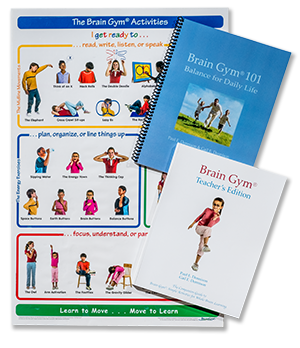
Depending on their length (one hour to full day) Introductory Workshops may include a few, or all of, the Brain Gym movements, and a taste of what the balance process is like. It is also possible to learn about the 26 Brain Gym movements in various books. We recommend Brain Gym® Teacher’s Edition. (which is of use to many people beyond education!). Kathy’s book, Educate Your Brain, offers information on 12 key Brain Gym movements that most people tend to use initially.
The Brain Gym® 101 course consists of 24 course hours of instruction, commonly offered over three or four days. This training gives participants everything they need to use the Brain Gym techniques in their classroom or OT/PT/SLT practice, or with friends and family – and themselves – as well. Participants learn:
- All 26 Brain Gym movements and how to get the most out of them
- Brain Gym “balance” protocols, for seeing/reading, listening, writing/communication, focus, comprehension, organization, and whole-body coordination.
- Dennison Laterality Repatterning® to powerfully integrate the right and left hemispheres of the brain, creating communication and coordination throughout the mind-body system, as well as its companion, Three Dimension Repatterning.
- How to understand the Brain Gym process in light of current educational/brain research
- How to use these powerful tools to create an ease-filled, integrated state for yourself, your students and others
Who can become an instructor?
In North America, the requirements for becoming licensed include about 240 course hours of instruction, including a four-day Teacher Practicum. Most people accomplish this goal over about two years. Click here for the Licensure page on the Brain Gym website. In developing countries, the requirements are fewer. If this interests you, please contact the Foundation office.
Until licensed as a Brain Gym® Instructor/Consultant, people learning these tools are most welcome to …
• practice the Brain Gym “balance” session process with friends and family
• bring what they know into their normal workplace and incorporate it into their day of teaching, occupational therapy, and the like
• share informally, especially from a place of their enthusiasm!
Once people are licensed, they are authorized to teach Introductory Workshops and the Brain Gym® 101 course, and charge a fee for Brain Gym “balance” sessions.
Become a Licensed Brain Gym® Movement Facilitator - in just three courses
Would you like to become licensed as a Brain Gym® Movement Facilitator?
If you’ve already taken BG101, you’re one-third of the way there!
This new, quickly achieved “facilitator” category has just been created. Here are the basic details —
Becoming a “Brain Gym® Movement Facilitator” involves just three courses:
BG101 — the Brain Gym® 101 course
BG104 — Brain Gym® 26 Movements course (this is a new, for-credit intro course)
BG110 — the Movement Facilitator practicum course (details being finalized as I type this)
Full details about the BG Movement Facilitator track are at this link.
This new licensure track offers people like you
• the opportunity to teach others about Brain Gym movements, for a fee.
• a way to gain an income stream, that may support you in taking more courses toward full licensure as a Brain Gym® Instructor/Consultant, if that’s what you want to do
• a way to spread the word about the many benefits of the Brain Gym program, offering others the movement tools and concepts that may transform life for themselves, their family, clients, and students.
Once you’re licensed, you’ll be able to
• teach the BG104 course
• teach introductory workshops of up to 6 hours, where you share some of the BG movements
• charge a fee for offering these learning opportunities
• use the BG Movement Facilitator logo
This licensure does not authorize you to
• offer private balance sessions
• advertise as a Licensed Brain Gym® Instructor/ Consultant
• use or teach the 5-step Brain Gym balance process or repatterning
when teaching BG104 or intros (although you’re welcome to share
your enthusiasm for what can be learned in the BG101 course,
which we hope people will go on to attend)
What’s your first step?
Or, if you’ve already taken BG101, what’s your second step?
Taking the BG104 course — Brain Gym® 26 Movements
I look forward to sharing this great new course with you!
Where can I look for further information on Brain Gym?
www.braingym.org • 805-658-7942
Helpful links include these; there are many more.
Studies on Brain Gym
Find an Instructor / Consultant in the U.S. and countries around the world
Course listings around the world
Find an Introductory Workshop
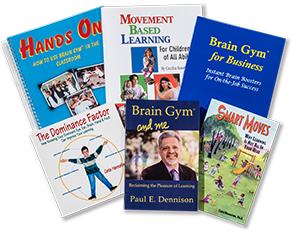
Numerous books, posters, and other support materials are available through
Edu-Kinesthetics, the Brain Gym Bookstore
www.braingym.com • 888-388-9898
Kathy Brown’s office stocks all the main book titles and posters.
You are welcome to make a purchase through her when you come for a personal session,
attend a class, or arrange for an office visit for this purpose.
The only book Kathy is set up to ship is her own book, Educate Your Brain.
Subscribe to Kathy Brown's email communications list
You can join one, two, or all three of Kathy’s email groups, for updates on:
• her Courses schedule • new Blog postings • her Book projects
like the upcoming Educate Your Brain for Reading
© Copyright Kathy Brown 2023. All rights reserved.
All photographs other than instructor portrait images ©Copyright Laird Brown Photography. All rights reserved.
Brain Gym® is a registered trademark of Brain Gym® International, Ventura CA
Please visit the Brain Gym® website at www.braingym.org.